So, I know what you’re thinking. “Rhianwen/Erin, Imbolc was five days ago! You’re late!”
To which I would say, technically it depends which calendar you’re following, and secondly, I’ve been so busy! And in fact, I’m not even mad that I’m only getting this blog post out now, because today marks the official end of my Imbolc observance, so I didn’t want to make this post prematurely and have to make another one.
I had wanted to start a new blog for a while, but the depths of winter did not feel like the right time. After an amazing summer last year, as soon as we hit mid September I was called once again like many of us on the Venusian path are to descend like Inanna in to the depths of my own personal underworld after my relationship, which was still very much in the honeymoon period, ended abruptly, coldly and without any forewarning. I spent most of this winter lying in bed, dreaming, reading, journaling, just trying to process the pain I was experiencing. Trying to move through it with grace and beauty like Queen Rhiannon, but also wanting to howl and screech and grow claws and fangs like a werewolf and tear everything apart. That was absolutely not the time to be starting a new blog. But Imbolc? Couldn’t be more perfect.
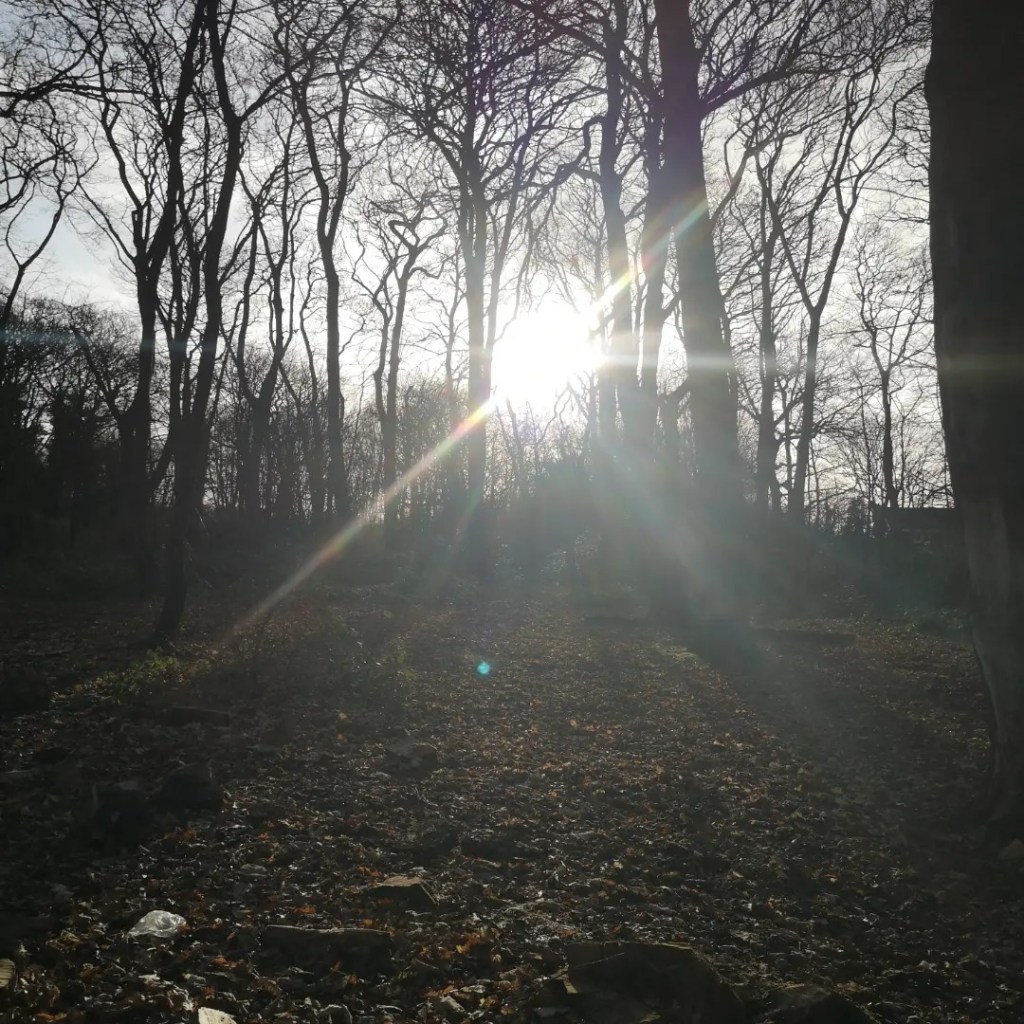
Whilst most contemporary Celtic-focused polytheists hold the Celtic new year to begin at Samhain, I cannot bring myself to resonate with that. For a while I have struggled to find the balance between my belief that spiritual cohesion and shared truths are important, but also not trying to force myself in to a paradigm that does not fit me. I needed the start of my year to be about newness, freshness, life, not descent and death. When I was a Filianist, we celebrated the new year at Spring Equinox (Eostre/Ostara). That always felt more fitting to me, and still does. In fact, I am torn between either Imbolc or Ostara as the new year in my personal wheel observance. I could be mistaken, but from what I understand, the Dianic tradition honours Imbolc as the New Year. Either way, I realised that if Ostara is the dawn, where we honor the Indo-European dawn/spring goddess and all Her cognates, Imbolc is the pre-dawn. When the sky is still navy blue, but you can see the sun’s light just slightly beginning to creep in, like this photo:

Brigid is, in one sense, a Dawn Goddess, much like the goddess Ostara/Eostre who is thought to be associated with Her (I will post more about this at Ostara itself). The IE Dawn Goddess (H₂éwsōs) is one of the oldest forms of Goddess we have concrete evidence for, up there with the Sky Father and Earth Mother. Brigid’s name is cognate with “the Sanskrit word Bṛhatī meaning “high”, an epithet of the Vedic Hindu dawn goddess Ushas. We know that Brigid’s name means ‘the High One’ or the ‘Exalted One’, and that early Hindu gods share some interesting similarities with Irish ones (see Danu, the same goddess name thousands of miles away from one another). Therefore, like Ushas, Eos, Aurora, Ausrine Eostre, Ostara, Thesan, Mater Matuta etc, Brigid may be related to H₂éwsōs, but her Dawn Goddess aspects seem less apparent than with those other goddesses and what survived Christianisation (through Her relegation to a Catholic Saint) the most were her other aspects, particularly those associated with healing.
She is ‘the goddess the poets adored’, and the spark of inspiration to begin new projects this time of year. But it is a gentle spark, and so in my desire to live in harmony with the cycles of nature I am trying to restrain myself from pushing myself too hard just yet when I am still feeling the dormancy of winter, and not yet fully out of my Descent period. That being said, I have started a new job, written the first chapter of my book, and started a course for work. Brigid’s energy has been the instigator in all of this. With Her wand, she gently awakens the land, and with that, all of us. It is a testament to how beloved this Goddess was that She not only survived Christianisation but remained one of the most beloved saints in Ireland, up there with St. Patrick. As of this year, St. Brigid’s day will be celebrated in Ireland as a bank holiday on February 6th. Like many saints, She is a bridge (fitting, given her name) between the Old Ways and the New. She was known not just in Ireland, but also in Scotland, England and Wales. In England, She was also known as Brigantia, the sovereignty/pastoral goddess of the Brigantes. Another fascinating thing is that while she has a consort and sons, She is the primary ‘character’ in her own Divine Drama, not just a mother of a divine son or wife of a divine father. We do not need to reclaim Brigid from patriarchy like we’ve had to do with some other goddesses. She always represented a sovereign matriarchal/matrifocal way of being, which is probably why she is one of the most primary goddesses of the feminist goddess movement.
I won’t dive too deeply in to Brigid’s mythology and correspondences outside of what I’ve already said. The point of me mentioning the Dawn Goddess aspects were because I feel as though it is an aspect of Her personality that is often overlooked, especially in an age when ‘the divine feminine’ is so strongly associated with the moon largely due to the influence of Wicca, the New Age movement and the desire to use comparative mythology to form a cohesive framework for a modern day pagan practice, also known as syncretism (which I do to some degree because I think it is somewhat necessary at times, but I find it sad it has erased the individuality of many of our native gods and goddesses in favor of fitting one binary formula). The other point was to show that while we’re not fully standing in the radiant, triumphant golden light of the dawn, her ‘cousin’ Eostre/Ostara right now, we’re almost there, and many of us may feel ourselves beginning to awaken once more. Brigid paves the way for Eostre to ride Her chariot across the sky. She is the light just beginning to rise above the horizon, the predawn. She is not the bright flowers and pink blossoms of spring, but the white snowdrop flowers that promise we are almost out of the cold, dark months.
As for how I’ve actually celebrated this beautiful festival and turning point in the wheel: I began celebrating and preparing for Imbolc last Sunday, where I went to the park, sang some songs, looked for materials to make a Brideog and a Brigid’s Cross with (I wasn’t sure what I was looking for and ended up leaving empty handed, so I decided to order some wheat stalks online instead) and looked for signs of the world awakening.
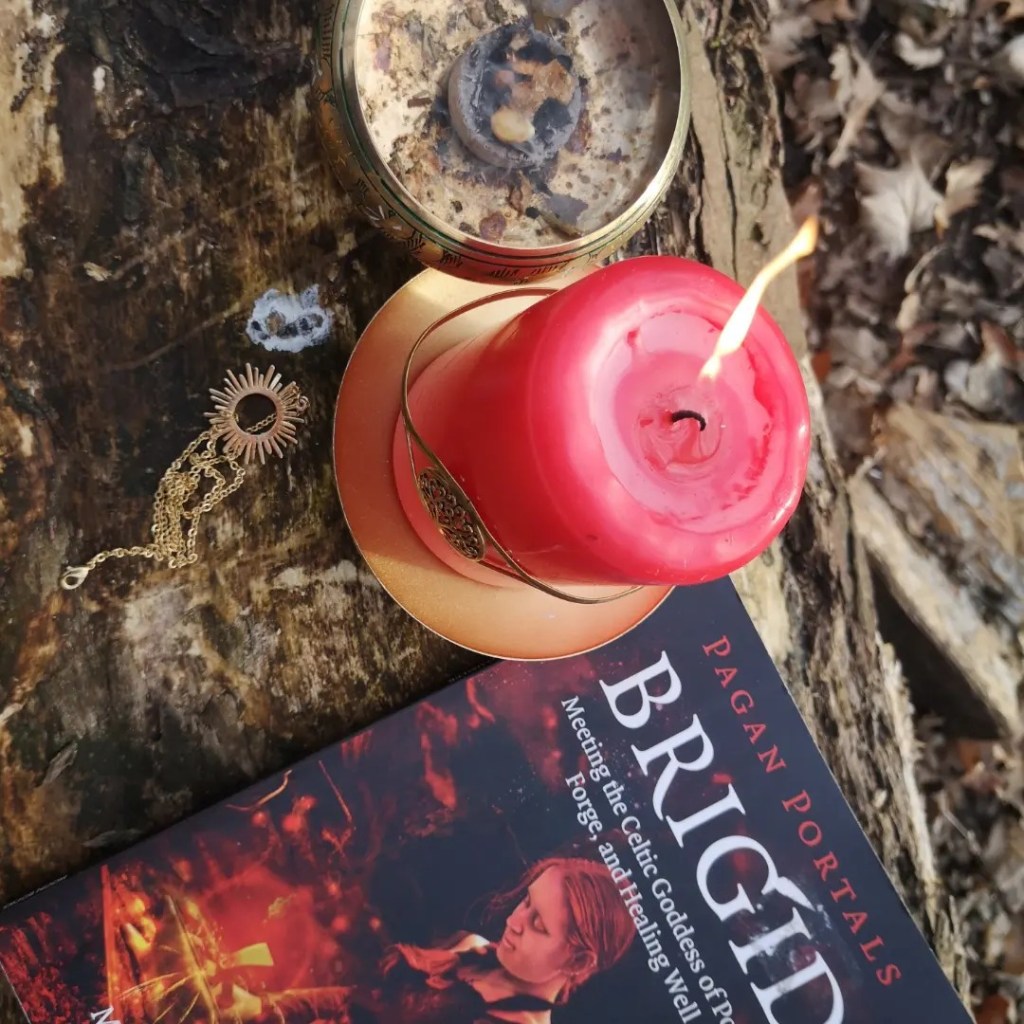

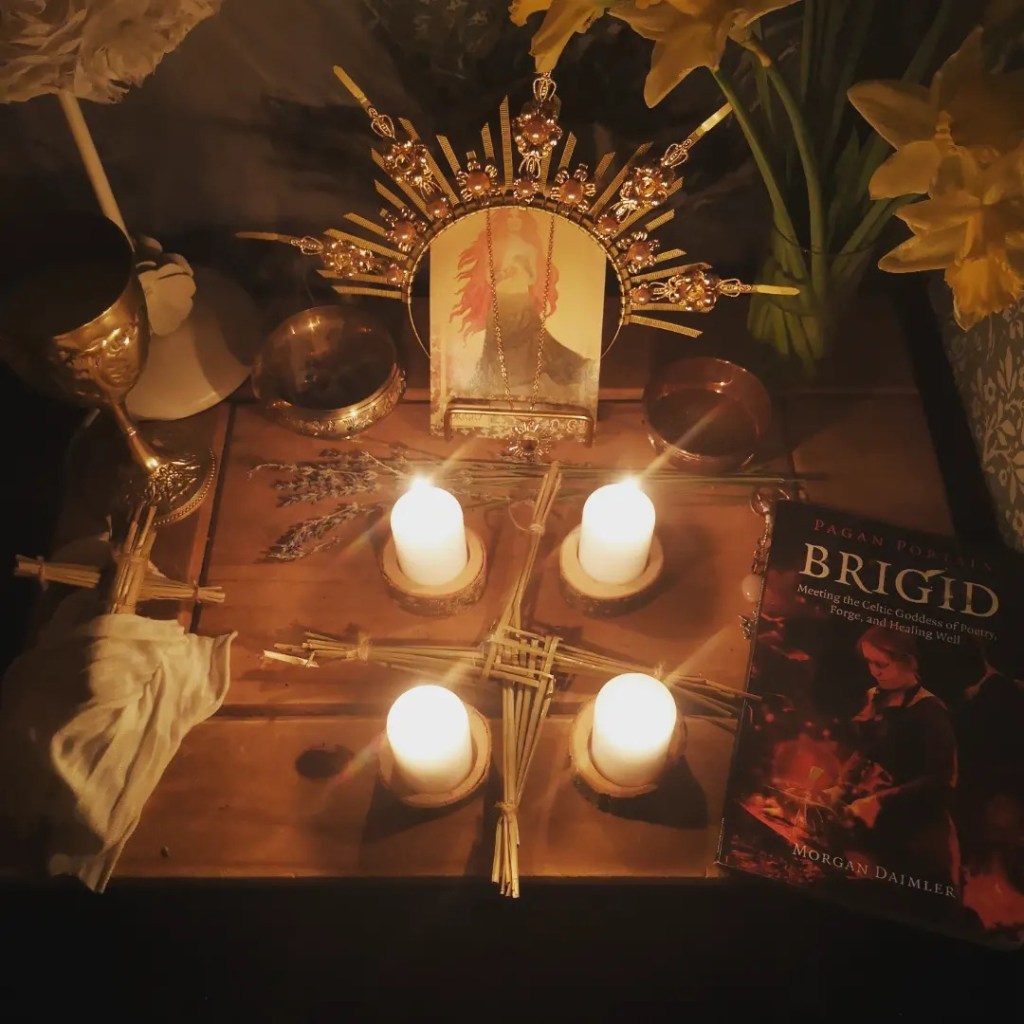
The night before Imbolc itself, after I got back from a different park, I made my Brigid’s Cross, my Brideog (‘little Brigid’ doll), set up my altar, took a cleansing bath, spent some time in prayer and set up a white-gold scarf for Her to bless on Her way by as She awakens the land. I did this last year and found it worked well with headaches and sore throats.


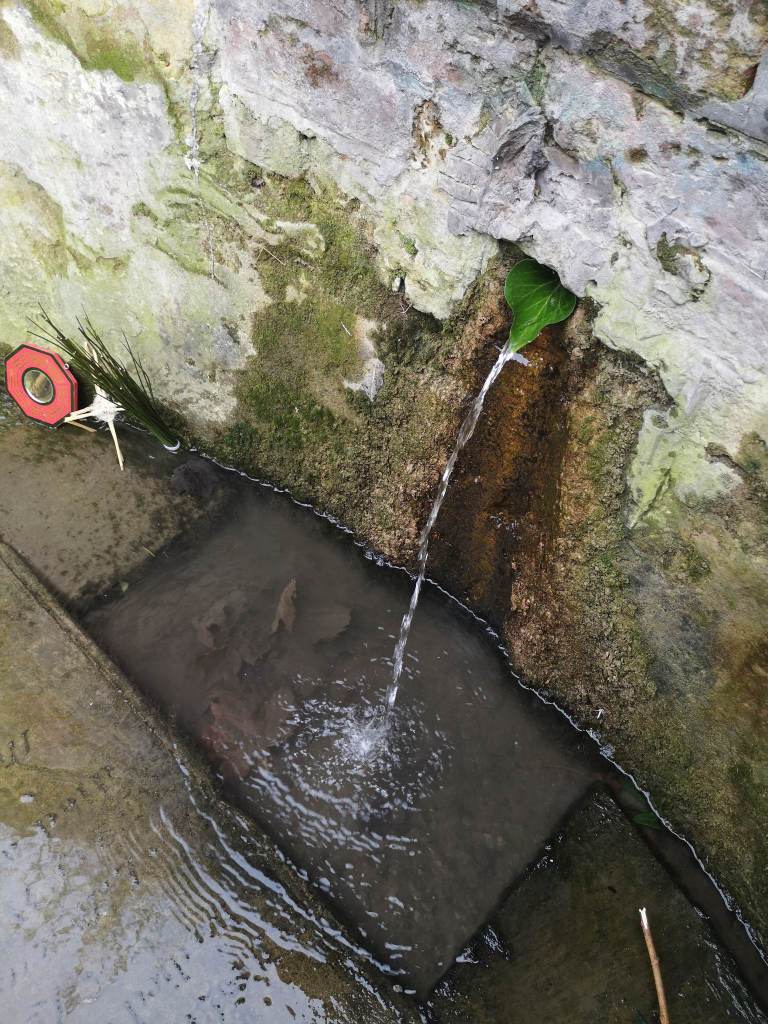
On Imbolc itself, I took part in a beautiful tour hosted by my city’s Irish society in honour of Brigid, where we were showed buildings and sites relevant to Her, and discussed Her many qualities. After this, we went to a spring sacred to Her in the Anglican cathedral gardens, where we all laid out our Brigid’s crosses, and held a sharing circle where we talked about what Brigid and Imbolc mean to us, read poetry and sang songs. I met some wonderful people and couldn’t have asked for a better day.

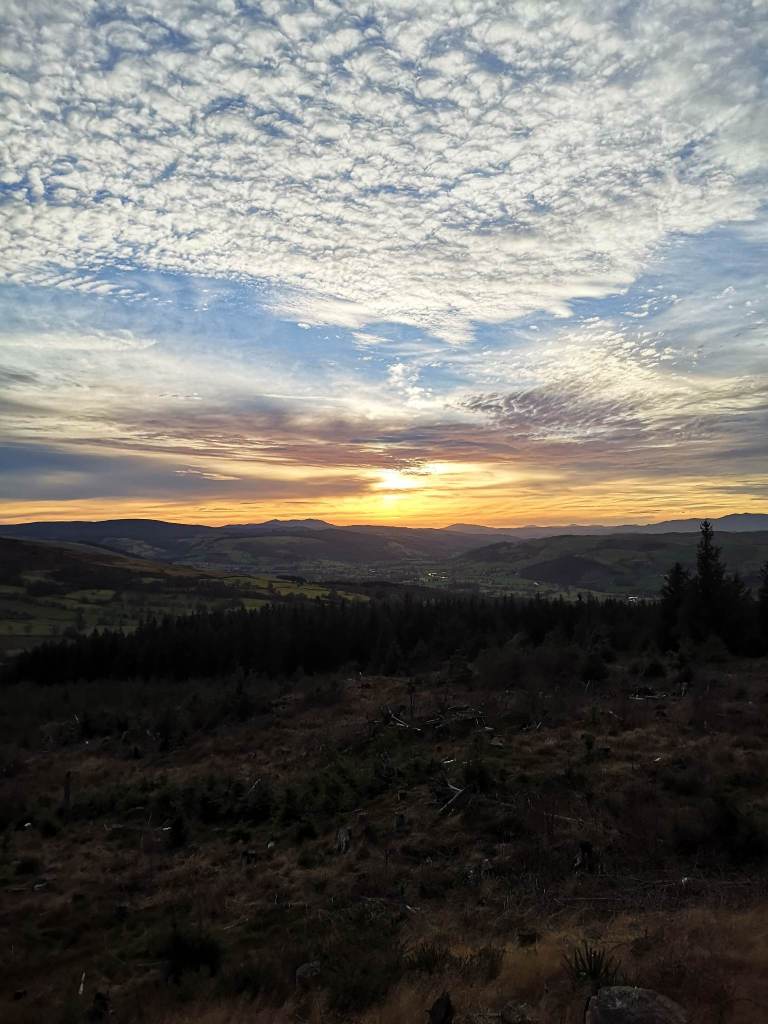
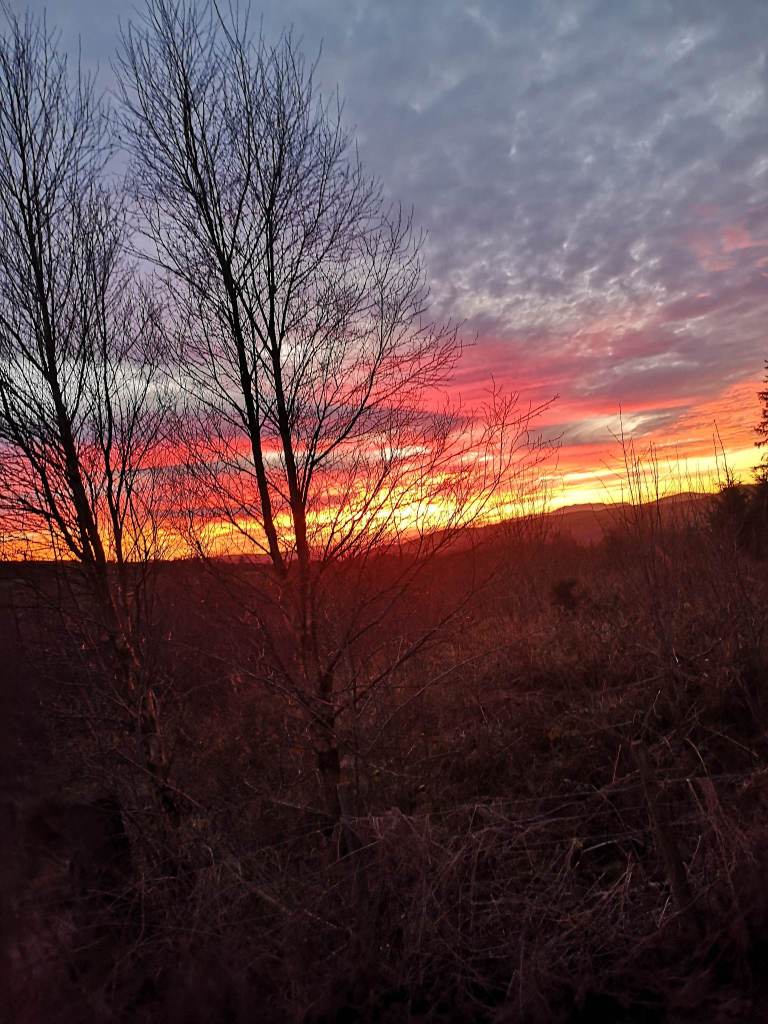
Lastly, on Sunday night, me and some beautiful sisters went to Wales for an incredible hike, where we sang songs and blessed the parts of the land that had been violated by humans such as destroyed trees and a cockfighting pit. The amount of healing I felt in these moments can’t be understated because it felt like while we were offering our love to the land to apologise and offer healing for the trauma She had faced, the land was sending love and healing back. My favourite moment on the hike was singing Wild Mountain Thyme/Blooming Heather, one of my favourite folk songs, with a sister called Bexi whom I’m convinced is an actual Disney princess. On our way back down, we almost got lost and ended up walking through wild forest where I almost fell over several times, but I didn’t: I think one of the benefits of my path becoming more earth-based and less heaven-based is that I’m learning to trust the Land a lot more to hold me, show me where I need to go, and not let me fall. I swear I’ve been a lot less clumsy lately on my outdoorsy excursions. When we got back to the off-grid retreat centre we were staying in, we ate a beautiful communal meal (I brought veggie curry), held a small ceremony, and spent the rest of the night under the stars and glorious full moon singing songs and talking. We then slept in a lovely little roundhouse, with the fire blazing all night to keep us warm.


To finish off, I’d like to say that while it’s fun to honour different deities across the Wheel at points that are most associated with them, you don’t have to wait for Imbolc to pray to Brigid and tap in to Her energy. She is always there. Whenever you’re going through a dark night of the soul and need to be reminded that there is light at the end of the tunnel. Whenever you need inspiration to finish a poem, song or story. Whenever you need healing of mind, spirit or body. Whenever you need motivation to spring in to action. I began my journey with Her this time last year, but this Imbolc especially, She has been there for me in a huge way, healing my broken heart and awakening me from my slumber. Please let her be there for you too.
Blessings,
Rhianwen
 Idylls of the Queen