I know I said I was done with the Beltane/Calan Mai/May Day posts but we’re still in Beltane season until the solstice so I lied. And I have a couple more ideas for Beltane related posts. So there.
One of the Beltane/May Queen goddesses I’ve not really talked about is Olwen of the White Track. She is much more obscure and not as widely acknowledged in Brythonic polytheism/the Avalonian based traditions as her similar sister-goddesses Gwenhwyfar, Blodeuedd, Rhiannon etc. (Creiddylad, Yseult etc too but they’re also quite obscure).

In the main text in which she appears, Culhwch and Olwen, she does not appear much in the story because obviously it’s a tale of Manly Knights doing Manly Knight Things, but she is the reason they headed off on their adventure to begin with, as in order to marry her, Culhwch has to go on an epic quest which will prove his worthiness to her father, Ysbaddaden (whose name refers to the hawthorne tree, an obvious link to Beltane), who will die if she marries. Many believe him to represent the old Winter King who does not want to give up his throne, with Olwen as the Flower Bride waiting to be set free from this overprotective paternal figure- one of the oldest examples of stories about fathers who believe no man to be good enough for their daughter, perhaps. This leaves Culhwch as the young, untested Summer Lord who needs the hand of the Flower Bride to begin his reign as Summer King.
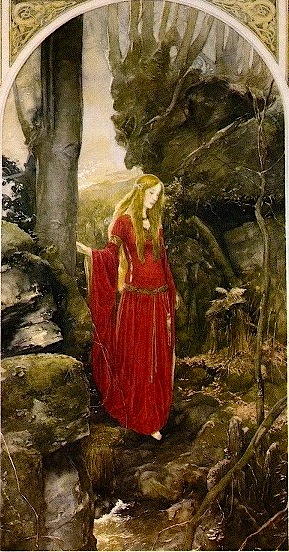
But what makes Olwen so different from the other Flower Brides (other than it being her father and her potential lover who she is the hinge in the love triangle between and not two lovers) is, to me, she seems to have more agency. We do not hear things from her point of view, but she seems to actually be attracted to Culhwch. Culhwch asks for her hand, and she simply says her father won’t allow her to marry, not that she doesn’t want to. Red, to the Welsh Celts, was not, as far as we know, associated with sexuality as it is today, but represented the Otherworld (along with white). When we think of most of the Flower Brides, who many associate with the Maiden aspect of the Goddess, we think of them as wearing white. But Olwen, she wears red. From a contemporary comparative mythology and symbolism perspective, this to me indicates she is ready to become sexually active and enter in to the Lover stage of her life, the transitory period between Maiden and Mother. In the Avalonian tradition of Glastonbury Goddess Temple, Maiden, Mother, Crone is stretched to Maiden, Lover, Mother, Crone, with the Lover archetype representing Beltane (the Maiden instead represents Imbolc, the Mother at Lammas, and the Crone at Samhain). Olwen isn’t a passive figure who has little control over her fate like Creiddylad, or forced in to a marriage she didn’t consent to like Blodeuedd, or married for political reasons like Guinevere/Gwenhwyfar. She seems to actually want to marry, and it’s simply her father holding her back. Not to say that we cannot interpret the aforementioned goddesses as having agency too (the latter two definitely express agency in choosing who to love later on in their stories), but I feel like with Olwen there’s less reclamation that needs to be done. As well as her signature red gown, she is described as wearing many rings upon her fingers, and a necklace of red gold and jewels. She is fully aware of her beauty and sexuality, as opposed to a white-robed, demure, innocent maiden. It’s UPG and modern comparative mythology, sure, but I feel like Olwen is, probably along with Gwenhwyfar, the Flower Bride who is the most aware of her role as passionate Lover. Her red gown such as those worn in depictions of sensual Irish goddesses Áine and Medb, and jewellery worn by the likes of the Nordic love goddess Freya and Mesopotamian love goddess Inanna, tell her father “I’m not a little girl any more, dad.” I think about the way the Glastonbury Avalon tradition depicts Rhiannon, and that’s very close to how I view Olwen. I wonder if parts of Olwen’s energies are being channeled in these more modern depictions of Rhiannon as Lover Goddess.

Her name is said to mean ‘white track’. Where she steps, tiny flowers bloom below her feet. Like Brigid, and Ostara/Eostre, she arises from the underworld out of slumber to awaken the land. Today, while I was walking through a local green space to feed the birds, there were thousands of daisies. One of the best things about this time of year is the little wildflowers that cover the grass. There were so many daisies that I could smell them in the air as I walked. I imagined myself as Olwen, awakening the land with my footsteps.

There is some etymological research to suggest her name means ‘Golden Wheel’, in contrast to the Silver Wheel of Arianrhod, which may make her a sun goddess, due to the fact that the word ‘olwyn’ is believed to have meant Wheel, though I’m unsure where the ‘golden’ part come from. As a spring/summer goddess, she certainly is aligned with solar energies. Arianrhod doesn’t have as clear of a connection to the moon as people may think (though she certainly does with the stars), but as I’ve said in the past, modern interpretations of the domains of these deities aren’t invalid just because we can’t find indisputable proof for them. The silver wheel in Arianrhod’s name, if indeed ‘Rhod’ does mean wheel, I suppose could be due to her association with the Corona Borealis. That being said, I see no reason why modern pagans shouldn’t be able to associate Arianrhod with the moon. Moving back to Olwen, I get annoyed by the New Age and Wiccan idea that all goddesses are lunar and all gods are solar, when the Celtic pantheons and other European pantheons have no shortage of solar goddesses and in the Nordic tradition, the sun is female and the moon is male. One theory as to why there are more sun goddesses and moon gods the more north you get is that in warmer climates, the daytime sun is viewed as a harsh and aggressive force, associated with masculine energy, whereas the night is cool and gentle, associated with feminine energy. Whereas in more Northern climates, the nights are bitter and hard, whereas the warmth of the sun is benevolent and loving. I’ve always been drawn to solar goddesses, and Olwen is no exception.
In another story, Einion and Olwen, a young shepherd travels to the Otherworld, wins her heart, and the two marry and have a son named Taliesin (likely different to *that* Taliesin.) Olwen exercises plenty of agency in this tale, falling in love with Einion and wanting to marry him rather than him just pursuing her which is often the case in these stories. She has two sisters, pointing to a triple goddess, like Gwenhwyfar in the Welsh Triads, the three Brigids etc.

I have read her described as being the keeper of the Apple Orchard of the Otherworld, a role that is often given to the god Afallach, his daughter Modron, Morgan le Fay, and various sovereignty goddesses associated with the Otherworld. Given Olwen fits nicely in to this archetypal ‘family’ of Otherworld deities, and her associations with the colour red and love, I can accept this correspondence on the grounds of syncretism and comparative mythology, although I would like to find the source for it and the direct justification. Honestly, a lot of these sovereignty, love, spring and Otherworld goddesses are so similar that it can be hard to discern where one ends and one begins.
We can interpret Olwen as triple-aspected: when she is with her father during winter, she is the Lady of the Underworld. She then leaves with her lover to the upper world to bring about Spring, making her almost like a reverse Persephone. She is also a solar goddess, giving her heavenly connections. As such, she can be seen as Lady of the Underworld, Lady of the Earth, and Lady of the Heavens, just like Ostara/Eostre.
The theme for the 2019 Glastonbury Goddess Conference was ‘Sun Lover’, a combination of the solar goddess & lover goddess archetypes. I cannot think of a better candidate for this than Olwen other than maybe Áine, who is an Irish goddess and therefore not as much of an ideal fit for an Avalonian tradition, but still relevant. I believe Áine was honoured as I read the little Sun Lover book published after the conference, but did not recall any mention of Olwen, which is a shame. I would love to see this powerful, beautiful, sensual, loving Goddess honoured more among those of us who gravitate towards Welsh traditions and the more neopagan, sacred feminine focused Avalonian traditions, especially at Beltane/Calan Mai, which is her time of year.
If you wanted to build an altar for Olwen, at Beltane or any time of year, here are some things you could include:
- Small white wildflowers, especially trefoils
- Gold rings and necklaces
- Solar imagery and crystals associated with the sun
- Red altar cloth, red candles
- Rubies
- Broom flowers
- Red roses
- Hawthorne flowers
- A printed off painting of her, or a drawing you’ve done yourself
- Makeup
I believe Olwen encourages women to embrace their beauty and sexuality, inflames the passion between lovers, and encourages women to be active participants in our own love lives. However, the fact that Culhwch had to perform thirteen impossible tasks to be able to marry her shows that we should have high standards for who we choose as our lovers, and we can invoke our inner masculine, our inner father, to hold that boundary for us if we feel we cannot do it through our feminine. She also tells us that ‘vanity’ is not a sin and its okay to want to dress up, wear makeup and jewellery to feel sexy and confident. When I put on my red dresses with matching signature red lipstick and gold jewellery, I instantly feel a boost of confidence and sexual, feminine power: Olwen’s influence. She also does not need to wait for a lover to awaken her sexuality, she seems capable of doing it herself, though she awaits her king to have someone to share it with. Therefore, she reminds me that I am capable of embodying the Lover Goddess and embracing my sensuality and sexuality whilst single, awaiting my king or queen to share it with.
Hail to the triple-aspected Lady of the Underworld, Lady of the Earth, and Lady of Heaven. Hail to the May Queen and Her King. Hail to the Summer!
~ Rhianwen
 Idylls of the Queen