Beltane/Calan Mai
Clover blooms in the fields
Spring breaks loose, the time is near
What would he do if he found us out?
Crescent moon, coast is clear
Spring breaks loose, but so does fear
He’s gonna burn this house to the groundHow’s one to know?
I’d live and die for moments that we stole
On begged and borrowed time
So tell me to run
Or dare to sit and watch what we’ll become
And drink my husband’s wine
Ivy by Taylor Swift
The Wheel of the Year turns once again to Beltane/Calan Mai, by far my favourite holiday and time of year. Last night, before laying my offerings, I sang songs to Gwenhwyfar and Rhiannon, and also acknowledged Olwen, Blodeuedd, Creiddylad as May Queens whose energy is strong this time of year.
I also acknowledged these ladies’ consorts, particularly Edern/Ydern the Sparrowhawk Knight as Gwenhwyfar’s lover in the Otherworldly faery realms, and Arthur as her earthly consort.

Edern ap Nudd
But wait, who is Edern?
Edern/Ydern/Isdernus/Yder, known as the Sparrowhawk Knight is a lesser-known Arthurian knight who appears in both antagonist and heroic roles in roughly equal measure, but in most of these stories he always ends up reconciled with Arthur. In the ‘Romance of Yder’, it is Arthur who is antagonistic, being depicted as a selfish and borderline-tyrannical king, and Ydern is depicted as a young, courageous, noble but untested young man desperate to prove himself. He is also a son of Nudd, like Gwyn. Nudd is likely identical with the proto-Brythonic god Nodens. Gwyn is an Otherworldly faerie figure, Lord of the Wild Hunt, which would likely make his brother Edern more-than-human too.
But here’s where it gets interesting. In a cathedral in Italy, Arthur and Edern (as Isdernus) are depicted rescuing Guinevere from a tower, in a motif that parallels the later abduction of Guinevere by Melwas and then Maleagant, in which she is rescued by Lancelot. In an early version of Tristan and Isolde, there is an allusion to Edern being a lover of Guinevere. In the ‘Romance of Yder’, his lover is a ‘Guenloie’, who is likely a split-off version of Guinevere created to keep two traditions alive: Guinevere as the wife of Arthur, and Guinevere as the lover of Edern, without upsetting Christian morality and monogamy norms. In the Modena relief, Edern/Isdernus is not wearing armor, unlike the other knights, which could point to his Otherworldly faery origins, and the fact that in courtly love romances, knights were often depicted as vulnerable before their ladies.
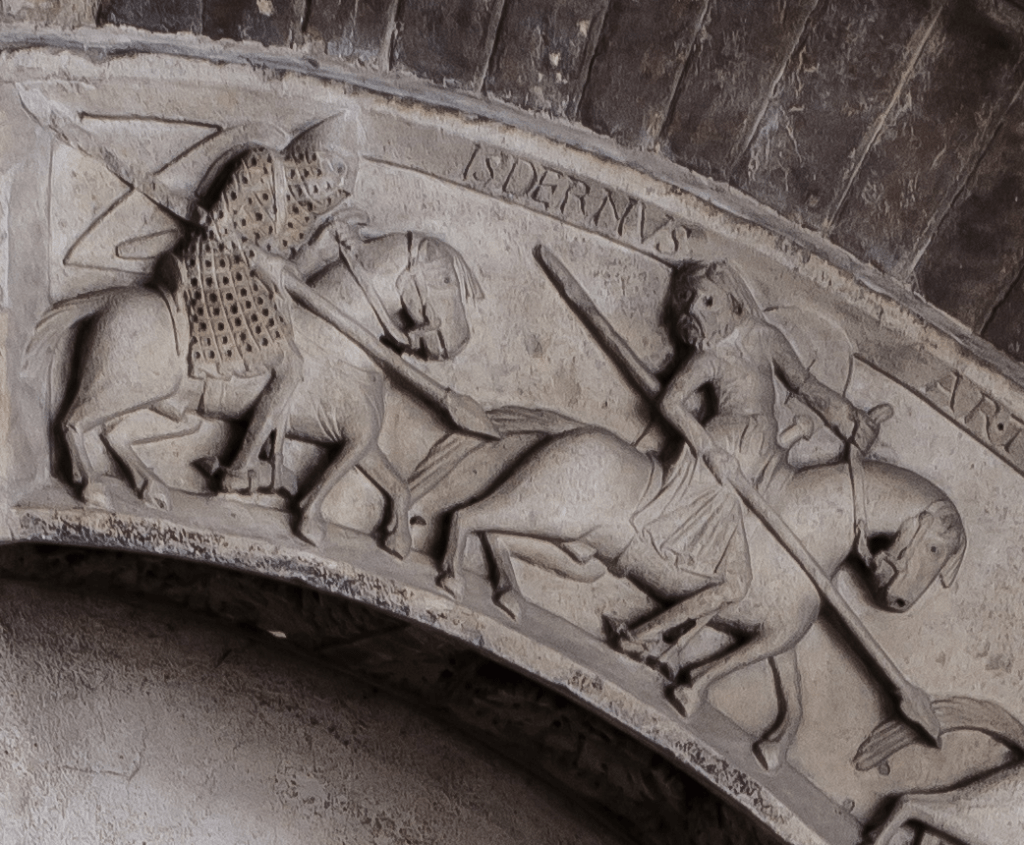
The evidence, to me, seems to suggest that Edern was ‘the original Lancelot’, serving as Gwenhwyfar’s original protector and lover. At first this conclusion was mostly academic and based on research, but I was experiencing such a strong sense of intuition that this was the truth Gwenhwyfar was pushing me to find. Last night, on the eve of Beltane, I had a dream in which she confirmed this for me. I couldn’t believe it. On Beltane! How fitting and magical. I have jokingly said that this discovery has been ‘my Da Vinci Code’ and dubbed it ‘The Modena Code’.
Constructing A Unique Mythognosis
As I have discussed prior, the ‘Gwen’ in Gwenhwyfar’s name means something like white, holy, or blessed. The ‘Hwyfar’ means something like phantom, enchantress, or fairy. In Culhwch and Olwen, Arthur lists Gwenhwyfar among his most prized possessions, many of whom seem to, based on their names, possess magical and otherworldly characteristics. Considering his raid on the Otherworld in Preiddeu Annwfn, is it possible Gwenhwyfar was one of his spoils? A faerie maiden of the Otherworld taken from her home to legitimise the Sovereignty of a mortal king?
Considering the story in the Italian cathedral is parallel to the story of Guinevere’s abduction by Melwas who is identified with Gwyn ap Nudd, an Otherworldly faery king associated with Glastonbury and Avalon, here is the brief shape of my UPG around this whole love… diamond? Square? Please keep in mind I am not presenting this as The Truth, just mine, based on a blend of research and intuition, plus Gwenhwyfar’s messages to me herself.
- Gwenhwyfar is a Queen or perhaps a Princess of the Otherworld.
- Faerie Lords/Kings/Princes Gwyn (who later becomes Melwas, Mardoc and Maleagant) and Edern (who later becomes Ydern, Yder, Isdernus and somewhat Lancelot), brothers, are in love with her. The former represents winter and death, the latter represents summer and life, like several other Celtic love triangles including the one from Culhwch and Olwen in which Gwyn is also involved.
- But there is a third contender in the battle for Gwenhwyfar’s here, too. Arthur, King of the Britons. Perhaps he loves her, perhaps he seeks her hand in marriage to legitimise his sovereignty and claim to the throne. I have mostly positive feelings around Arthur, but I’m aware he is still mostly seen as a Christian king with his own agenda, although he may have earlier origins as a pagan bear god. He finds Gwenhwyfar in the Otherworld and consensually or not, the two end up married. Perhaps this was done to forge an alliance between the Otherworld and the mortal world, as several knights and ladies who seem to have Otherwordly origins end up becoming loyal to Arthur, not just Gwenhwyfar and Edern.
- Edern joins Arthur’s Knights of the Round Table in order to stay close to Gwenhwyfar and protect her even in this new, dense, material world of men and a foreign religion.
- Years go by, Gwenhwyfar beside Arthur as his queen consort, Edern watching from the sidelines. Edern comes in to relative conflict with Arthur a few times, but always ends up remaining loyal to him. Gwenhwyfar learns to appreciate Arthur and believes him to be a good king trying to do right by his people and understands her role in protecting Albion by staying by his side and embodying Sovereignty Herself.
- Gwyn, rightfully annoyed a Christian king is treating a divine faerie goddess as his own possession to legitimise his sovereignty, kidnaps her and takes her back to his Glass Tower in Avalon/Glastonbury. Gwenhwyfar may or may not have complied.
- Arthur, Edern and the other knights show up to get Gwenhwyfar back.
- Gwenhwyfar is returned to Arthur, but her and Edern remain as lovers in secret, much like how she is written with Lancelot.
- Eventually this is revealed. Arthur is destroyed and his sovereignty is lost as he no longer has the favour of the Sovereignty goddess, in the form of his wife, Gwenhwyfar.
- The stories are written down by monks and scholars, and carved into cathedral walls. Gwyn becomes Melwas/Maleagant/Mardoc/Mordred, Gwenhwyfar becomes Guinevere, Winlogee and Guenloie, Edern becomes Yder, Ydern, Isdernus and… Lancelot.
- Edern is canonised as a Christian saint, like many other Celtic deities and Otherworldly/faery figures.
A Note on Totemic Animals
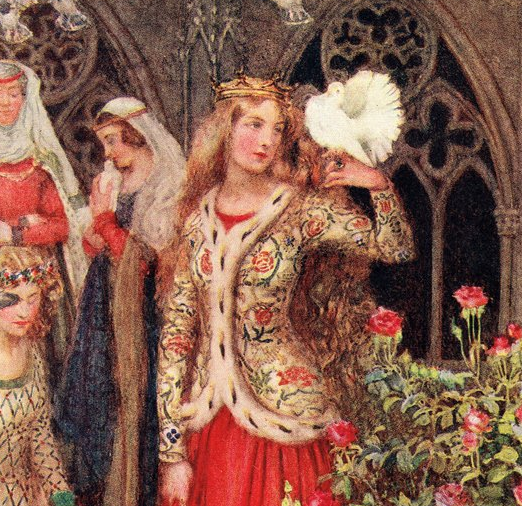
Many Celtic deities are associated with birds, be it birds in general or specific ones. Rhiannon has her Adar Rhiannon, whom I see as songbirds; sometimes robins, sometimes blackbirds, sometimes three different coloured birds whose species I cannot quite place. Cliodhna, the Irish goddess, has similar magical birds. Brigid has a swan. The Morrigan, Morgan le Fay, Bran and Gwyn ap Nudd are all associated with crows and ravens. Bran’s sister Branwen has both the white raven and the starling. Blodeuwedd is of course the owl. Lleu is a majestic eagle. Edern is known as ‘the Sparrowhawk Knight’, and I believe that to be his totemic bird. Gwenhwyfar, though it may be UPG, I associate with a white dove, a classical and Near-Eastern symbol of the love goddess, and Guinevere is syncretically linked to Aphrodite/Venus. She is sometimes depicted with a dove in art. Having just Googled ‘Guinevere and doves’, it turns out doves are actually associated with her in a Grimm brothers tale of Guinevere and Arthur.
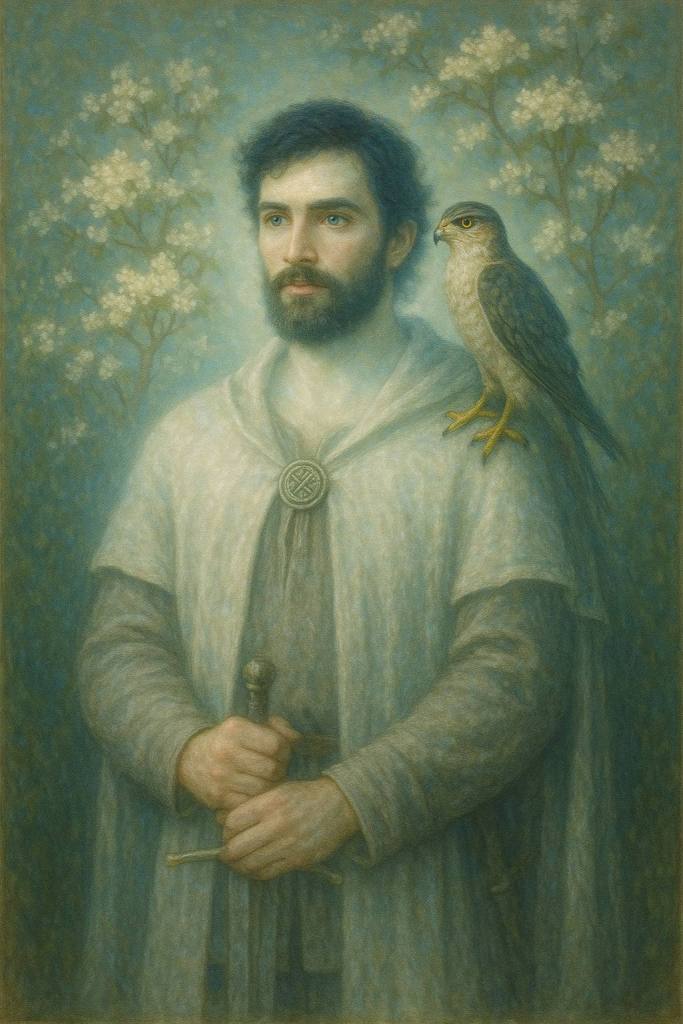
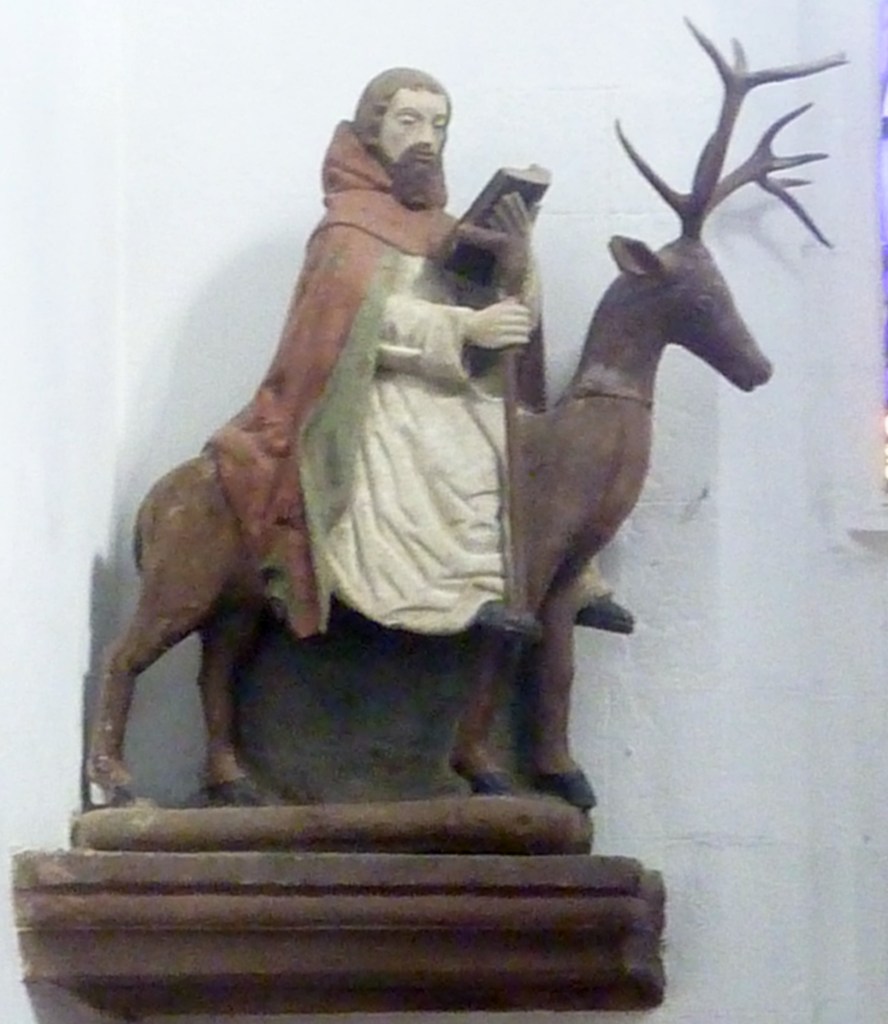
In his saint/monk form, Edern is depicted riding a stag, an obvious symbol of the Celtic Divine Masculine that can symbolise death and rebirth due to their shedding and regrowing of their antlers.
In Praise of Guinevere
Navigating the world of UPG vs attested sources can be confusing. I would never want people to end up stumbling upon this personal blog entry annoyed at me for trying to preach that my UPG is The Truth, but I’m certainly not the only one who believes Edern to be Gwenhwyfar’s true love, even if the specifics may be unique to me.
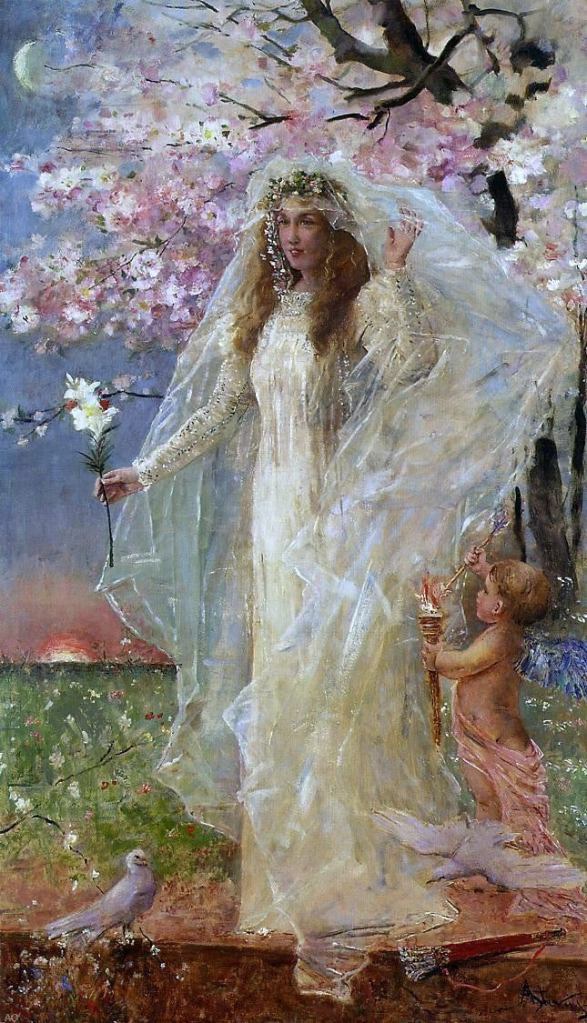
But as a Sovereignty Goddess and a figure associated with Venus, Gwenhwyfar’s love is not bound by Christian morality. She bestows it upon who she sees fit, for reasons I cannot begin to truly comprehend. Regardless of whether her lover is Edern, Lancelot, Arthur, Melwas, Mordred, multiple of these, or she has no consort at all, she remains my Lady, Venus of Albion, Sovereign and complete in herself with or without a consort. I can only implore you, if you are called to worship and work with Gwenhwyfar, to spend time with her, pray to her, and do your own research to figure out who you should honour as her consort(s). She is a most loving, warm but firm goddess who, just like she does with the knights in service to her, shows me how to become a better version of myself. She embodies the paradox of the Lady of Love who both loves you as you already are, and wants you to rise to meet her.
Beltane Blessings
This morning, I awoke early to go and collect morning dew from a local hawthorn tree. When I got there and found her bone dry, I instead just spent some time with her before heading back home to instead dab my face with dew from our own garden. Feeling refreshed, I called in the Wheel of Rhiannon and blessed and consecrated several pieces of jewellery to, Rhiannon, Gwenhwyfar and one to Venus. After that, I recorded a journey meditation for my Beltane gathering this coming Monday, for meeting your faery guide and Gwenhwyfar, which I can share if anyone wants it.
I intend to spend the rest of the day meditating on these themes, sacred union, and enjoying the beautiful golden May sun on my skin. Gwenhwyfar reunites with Edern, and the light half of the year returns. Sunday I am going to a Beltane event with my beloved who is a complete newbie to anything pagan related- breaking him in should be fun! I’ve told him to think of it as like church, but with more whooping, dancing, moving, sensuality, and acknowledgement that all of creation is sacred. On Monday I am hosting my third annual Beltane gathering with my friends- which I think will be the best one yet.
On May 12th, the next full moon- the ‘Flower Moon’, I will conduct a small ceremony in praise of Guinevere. I am currently constructing a system of lunar workings in which for each full moon in the 13 month year, I worship and work with a different Celtic goddess. The Flower Moon corresponds with Guinevere, and next will be Rhiannon.
Blessed Beltane, one and all!
Sources:
https://clasmerdin.blogspot.com/2011/05/modena-archivolt.html
https://clasmerdin.blogspot.com/2011/05/white-winter-king.html
https://clasmerdin.blogspot.com/2011/05/white-phantom.html
https://clasmerdin.blogspot.com/2011/07/isle-of-glass.html
https://clasmerdin.blogspot.com/2011/07/isle-of-glass-2.html
https://www.maryjones.us/jce/edern.html
https://nightbringer.se/the-legend-of-king-arthur/arthurian-characters/y-arthurian-characters/yder-the-son-of-nut/
https://api.pageplace.de/preview/DT0400.9780231879439_A39320851/preview-9780231879439_A39320851.pdf
https://druidry.org/wp-content/uploads/2023/01/Guinevere-as-Venus-revised.pdf
https://aegtte.weebly.com/de-bruidsjurk-van-guinevere-guineveres-bridal-gown.html


 Idylls of the Queen