
Hello beauties. I hope if you’re in the Northern hemisphere like me, you’re enjoying the last of our summer days.
Here in the UK it has rained most days for the past six weeks. We had summer solstice, and then immediately after the jet stream and low pressure has doused us with nonstop rain, a sharp contrast to the droughts and heatwaves of last summer. In a way, it’s a good thing. The land probably needed it. I remember this time last year spending a week down south, and everywhere we went the grass was brown and dead. This year everything is beautifully green. Green and soggy. I really miss the sun. I’ve spent so much time inside. Last summer I spent hours every day sitting in my back garden soaking up the rays and feeling the warmth of the Divine Lady Sun Goddess kiss every inch of my body.
Which is my segue in to the topic of this blog post. The solar feminine, and specifically, the ‘solar goddess of love’.
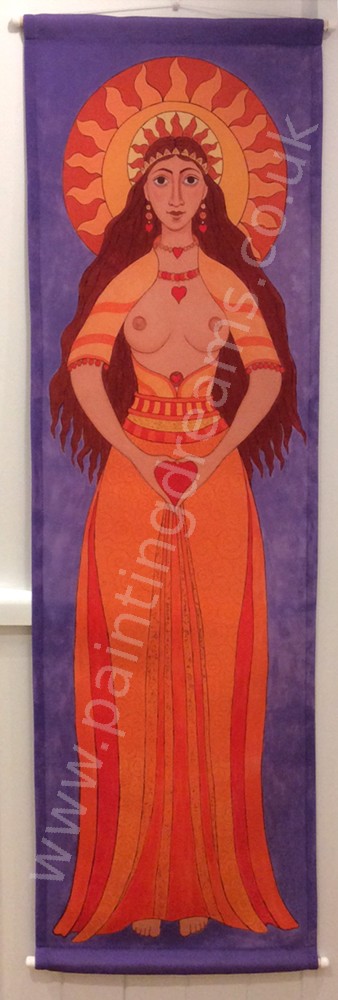
Last night at my moot, we listened to an illuminating talk about the origins of sun worship and the role it plays in our lives today as modern pagans. Most modern pagans focus more on the moon, which makes sense. In a world where solar energies have been the focus of patriarchal religion for thousands of years, and on a planet which is being devastated by global warming, it would make sense that many of us would want to seek refuge in cooler, gentler lunar energies- which are typically viewed as divine feminine energies. The sun, in many cultures, has been seen as masculine. This does make sense. If the earth is feminine, the womb of creation, the sun is the fertilising aspect of creation that joins in union with Mother Earth so that she can birth life. The rays can be seen as phallic, and the firey, sometimes angry nature of the sun can be compared to warrior-like energies. The moon and the earth, meanwhile, are typically seen as feminine, with the moon representing the mystical, intuitive aspects of the feminine (like the High Priestess card in the Tarot) and the earth representing the fertile, fecund aspects of the feminine (like the Empress card). This makes sense, and it works for plenty of people. For me, however, I’ve always felt more connected to not only solar energies, but specifically, divine feminine solar energies. I’ve tried, for years, to convince myself I should just do what everyone else does and go along with the solar masculine/lunar feminine dichotomy. I spend a lot of time in what many would class as ‘new age’ spaces, and that’s the party line at those. And I have no problem with them doing that, but it’s not me. It is so reductive and dogmatic to state with absolute conviction that the sun is masculine, when world history has gave us probably just as many sun goddesses as sun gods.

There are many reasons the sun has became much more associated with the masculine than the feminine in modern paganism and occult/magical thought. The incredible book Drawing Down the Sun gives some reasons for this, one of the major ones being the popularity of Max Müller’s theories at the time. Müller hypothesised that every single myth told the story of a heroic male solar god overcoming the darkness. His theories were later debunked, but certainly stuck around long enough to play an active role in what would later become the pagan revival movement. I’ll share a quote of hers below, but I really recommend buying the book and reading the whole thing. The chapter at the beginning, the Hidden Sun, goes in to a lot of detail about why the erasure of the solar feminine has occurred.
Ultimately, an active female sun would not have agreed with the morals and social taboos of the Victorians. Their interest in a universal language and making ancient myths fit the mold of Christianity made it impossible for the solar feminine to be recognized. A woman playing such a vital role in religion didn’t fit into their worldview. The passive, gentle moon reflected the ideal woman of the time far better than the vibrant, sometimes warlike sun. The popularity of classical myths further ingrained as the norm the idea of male/sun, female/moon.
Drawing Down the Sun by Stephanie Woodfield
The solar feminine, to me, is also the Empress card in the Tarot just as much as the Earth is. She is Hemera. Helen of Troy. Eos. Aurora. Theia. Demeter. Dea Dia. The Sun Goddess of Arinna. Aditi. Hathor. Sekhmet. Bast. Isis. Aine. Etain. Epona. Alectrona. Rhiannon. Olwen. Gwenhwyfar. Elaine of Corbenic. Elen Luydogg. Iseult. Brigid. Grainne. Amaterasu. Sunna. Sulis. Eostre. Ausrine. Ostara. Hewsos. Saule. St. Lucia. Sai Rayya. Sophia. So many more.
While I do not want to bring gender stereotypes in to this so much (seeing as even the very fact that I view the sun as feminine contradicts typical modern Western gender associations), there’s a point I want to bring up here. Many people view the sun as masculine because its heat can be fierce, angry, full of rage, like a masculine warrior. In hot countries, the sun was often viewed that way (sometimes with sacrifices made to appease him). But in colder climates, especially in the North, the sun is more like a gentle lover, leaving kisses all over the land and radiating us with her presence. Some scholars have identified that Northern countries often opted towards sun goddesses, because its loving and gentle warmth would’ve been seen as feminine, whereas in hot countries closer to the equator the sun would be seen more as masculine because of its angry and often violent nature. Egypt is an interesting case because they had both male and female solar deities, and two solar goddesses who were two sides of the same coin, Hathor and Sekhmet, that embody both aspects of the sun.
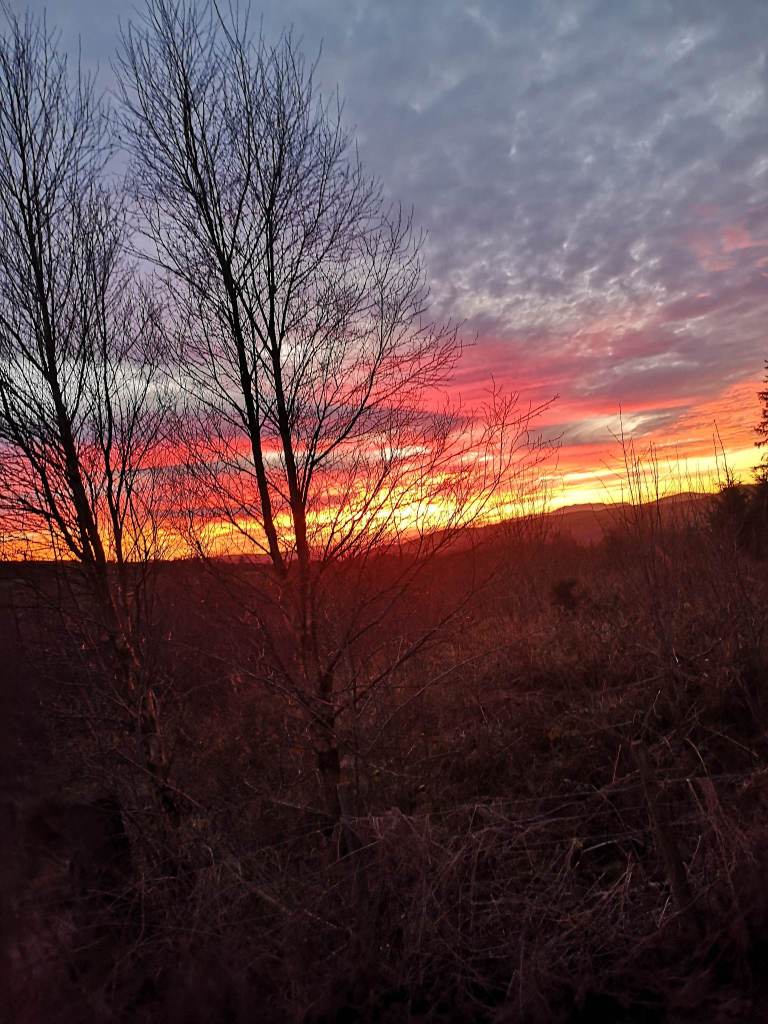
Since I live in the rainy UK and suffer from Seasonal Affective Disorder in the winter, the sun to me is like a gentle lover who awakens me from my slumber. She blesses the land, and me, with Her solar kisses. In the spring time, she signals the animals, the land, and us to awaken. Animals begin reproducing at Her call. When I lie on the grass in the summer (fully covered in sunscreen- gotta be safe) and lay back, the feeling of Her rays on my skin feels like being wrapped in pure, divine, ecstatic love. I have a high heat tolerance, and when most people are suffering through heat waves, I am living my best life sitting in the shade and reading a book in a cute sun dress. Her playful games of hide and seek as she retreats behind clouds and slowly re-emerges make for breathtaking works of art in the sky, which fill me with awe and remind me of the love the Creator has for all of us. When She rises in the morning, She paints the sky all sorts of different hues: yellow, orange, pink, blue, purple, as the birds sing for Her. When it rains, She paints the sky even more colours with beautiful rainbows. Just before She sets at night, She makes everything golden, and this is my ideal time to take selfies because I have warm undertones and cool lighting does nothing for me! Even in the winter, She is a paler and cooler shade of yellow, but in some senses even brighter, and clear winter days can be just as exceptionally beautiful as summer ones. One of my favourite words is ‘Apricity’, which refers to the warmth of the sun in winter. I think of the Sami people, who have worshiped the sun for thousands of years in their icy climate, and the love they have for Her as she brings love and light to their frozen landscapes.
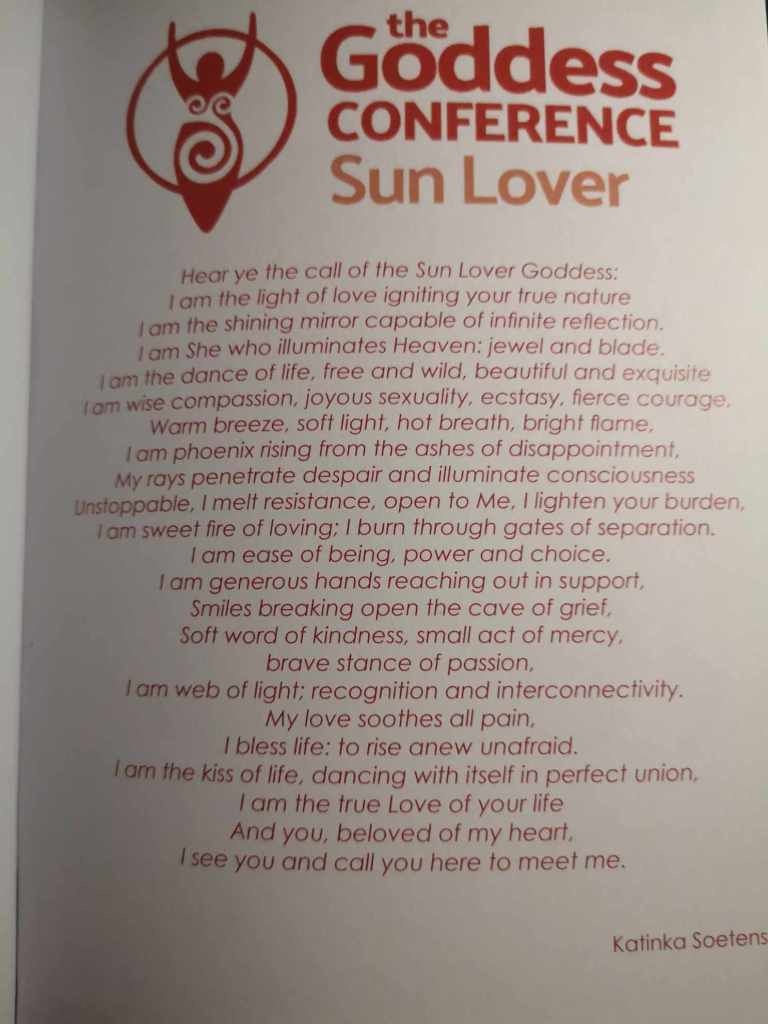
For these reasons, the sun, to me, is a symbol of love in all its forms: the love of a mother for her children, the altruistic love we ought to have for all of mankind, the love of a romantic couple in the throes of passion on their wedding night. I feel deeply connected to what I call the ‘Solar Goddess of Love’, which, interestingly enough and annoyingly enough because I wasn’t there, was the theme for the Goddess conference in 2019. The problem is, I don’t know what name I should call Her by. An obvious choice for a solar love goddess would be Hathor, but I know so little about Kemetism and have no connection to the land of Egypt, and want to stick in my relatively nearby and/or ancestral spheres. There is also Eos/Aurora, who takes many lovers, who is very near and near to my heart and I am incredibly fond of the Indo-European dawn goddess in all her forms, but again, I want to stick to the Celtic spheres. I have some hunches, and I have nailed it down to a few choices. I’m focusing on Celtic goddesses who I can link both to love and the sun, not one or the other.
Olwen
Olwen was the focus of an article I wrote in May here. I’ll touch on something here that I didn’t very much there, though. One aspect of the sun goddess, and the sun in general, is that of the descent in to the underworld and ascent back out of it. This is typically associated with Venus because of Her journeys through the sky, but the sun literally makes this same journey every night. In my research into Olwen as a sun goddess, I found several articles arguing that Olwen’s story can be interpreted similarly to that of Creiddylad’s, Guinevere’s and Blodeuwedd’s love triangles, aka the goddess being with the king of summer/solar hero half of the year and the king of winter/otherwordly champion the other half of the year (consensually or non-consensually, depending on the story and the lens through which the story is interpreted- but that’s a topic for another day). The difference is, the ‘winter king’ in Olwen’s story isn’t a lover, but her own father who will die if she marries. Her father, Ysbaddaden Bencawr, is an ancient giant, representing the old order (winter) trying to cling to his throne. The young Culhwch, then, is the untested solar hero seeking the hand of the Goddess. This story in the Mabinogion also features the love triangle between Creiddylad, Gwythyr, and Gwyn ap Nudd. Gwyn is the King of the Otherworld/Underworld (the two are often conflated and seen as one in the same). The ‘otherworldly champion’, ‘winter king’ figure represents cthonic values of darkness, chaos, magic, death and descent in to the underworld. When the solar goddess, or the nature goddess, is with him (be it as her father or her lover), she is in the underworld. When she is with the solar champion, who represents order, law, life, and logic, she is on the land or in the sky. The night and winter are obviously thematically connected, as are the day and summer. In this regard, Olwen and other sun goddesses can be seen as psychopomps, bringing their light to the dead and the souls in the Underworld when they descend down there at the dark half of the year, and bring them life anew as reincarnated souls at the start of the bright half of the year, like the Divine Daughter in Filianism. As I said in my original Olwen post, in my UPG Olwen is a ‘Lover archetype’ goddess and I associate her with sacred sexuality, viewing her similarly to how Rhiannon is often viewed in the Avalonian traditions of Glastonbury.
Rhiannon

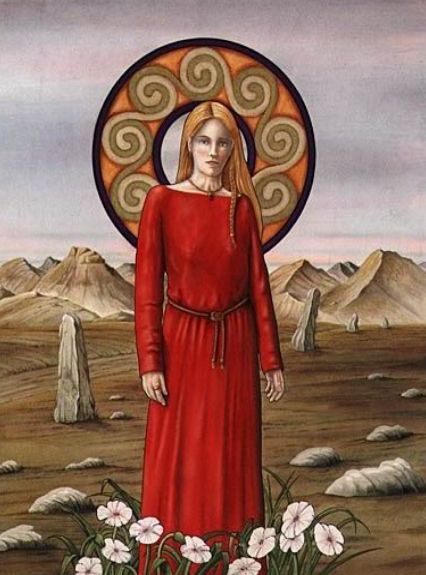
Rhiannon, in modern pagan circles, is for some reason often viewed as a lunar goddess. To be honest, I’m yet to find the reason for this. A big part of me wonders if its to do with the fact that the witchy figure in the song Rhiannon by Fleetwood Mac has become conflated with Rhiannon of the Mabinogion to the point people can’t tell where one ends and the other begins. More likely, though, it has something to do with the Wiccanised ‘every goddess is a moon goddess’ idea that is still firmly embedded in the Neopagan collective consciousness. Rhiannon, to me, is solar. She wears a gold dress, an undoubtedly solar colour, and is obviously a horse goddess. Horses, in most Indo-European traditions, represent the sun and the solar chariot. She, too, can be interpreted as a psychopomp figure in some senses, with her birds, the Adar Rhiannon, that can ‘wake the dead and lull the living to sleep’. At this year’s Goddess conference Katinka Soetens did an amazing talk on birds as psychopomp figures. Her journey across the land in her gold clothing (solar symbol) on her white horse (solar symbol) mirrors the journey the sun takes across the sky each day. While not much in Rhiannon’s story points to her being an obvious ‘love goddess’ upon first reading, her union with a human man to bless him with the sovereignty of the land can be read similarly to ‘Hieros Gamos’, the love-making between a priestess of the Goddess Inanna and a King in the Middle East to bring prosperity and abundance to the land. In this sense, many Celtic sovereignty goddesses can be read as love goddesses, but Rhiannon’s story speaks of not only love for a mortal man that she chose, but love for humankind, when she chooses to accept her punishment even though she knew she didn’t kill her baby rather than call her traitorous handmaidens out for lying. Today, many of her devotees have had direct experiences with her in which she manifests to them as a goddess of love, beauty and sacred sexuality, and that makes infinitely more sense to me than viewing her as a goddess of witchcraft and the moon, which some modern sources claim her to be. Many modern artistic depictions of her, such as the one above, depict her in red rather than gold. Possibly for two reasons: showing her as a goddess of love and sexuality, and also because the colour red is associated with the Otherworld from which she hails. Many of these depictions remind me of Olwen or Aine. I love the picture above, because of the large sun behind her. I assume the aquatic imagery is because of her later marriage to Manawydan, often interpreted as a sea god cognate with the Irish sea god Manannán mac Lir. I’ve seen other more modern ‘love goddess’ depictions of her with the sea, too, so I’m wondering if it’s also some syncretism with Aphrodite/Venus going on.
Áine

(Content warning for rape). Alright, hands up, I know fairly little about Irish paganism (other than Brigid) and I have not sat down and properly read Áine’s story. After writing this article, I’m going to make a concerted effort to do as much research on her as I can. From what I understand, she is a ‘fairy queen’ (which we all know is basically code for goddess) who is raped by various men seeking to be king, as she is a sovereignty goddess, like Rhiannon, and one must join in sexual union with her to be able to rule. However, it must be a union she consents to, as it is HER choice who the king is, and HER choice who she will sleep with. She righteously punishes these vile men and remains a powerful, sovereign goddess of love and beauty, and takes several lovers. Some believe her to be the lover of Manannán mac Lir, though some have him down as her father. Her name means ‘brightness, radiance, glow’ which obviously points her to being a sun goddess, though some interpret her as a moon goddess also. She is celebrated at Midsummer, obviously pointing to her solar associations. I placed her oracle card on my Midsummer/Litha altar this year. Considering her links to Manannán, her sovereignty goddess status, and the fact that she is also associated with horses, it’s reasonable to wonder if she derives from the same proto-goddess as Rhiannon, though I can’t prove that and would have to read more in to it. Some believe Áine’s sister to be another Irish goddess Grian/Gráinne, who weds the god of the underworld. Gráinne may also be another aspect of Áine herself. The two potentially represent the sun goddess in the light half of the year, and the sun goddess in the dark half of the year. Certainly Gráinne aligning herself with the god of the underworld points to the love triangle of seasonal sovereignty we see played out in Celtic myth again and again. I really like this idea of two sister sun goddesses for both halves of the year because, since I’ve been a kid, I’ve always felt like the winter sun and summer sun had very different energies, almost like they were two different luminaries. There’s a great article on this here.
There are a few honourable mentions, whom I also considered, but didn’t have enough to say on to justify their own paragraphs.
- Iseult: Not a goddess so much as a literary figure (but then the same can be said of a lot of the goddesses I worship, and it’s possible she, like many of them, is a humanised form of an earlier goddess). No direct links to the sun but her role as a skilled healer (the sun can be associated with healing) and a quote I read a while ago (see below) make me consider her a solar heroine. She is also, obviously, a figure associated with love and beauty and has been compared to Helen of Troy, another solar love figure.
- Elen Luydogg: While this story in the Mabinogion basically just serves as justification for the Roman colonisation of Britain, Elen’s depiction as a regal, golden-garbed (see a pattern here?) queen calling to the man she loves through his dreams to come and take his place by her side is very beautiful if you strip back the whole colonisation thing. The figure of Elen is a complicated web to untangle. There are a few different Elens all associated with Wales and sovereignty and to be perfectly honest with you I still don’t know where one ends and another begins. Don’t even get me started on the Elen of the Ways debate. Caitlin Matthews in the incredible book King Arthur & the Goddess of the Land speculates that she is related to Elaine of Corbenic, and though this is highly speculative conjecture, it’s worth mentioning. Wonderful priestess Ann of the Sheffield Goddess Temple wrote an article on similar lines about this elusive Elaine/Elen figure here as she was a goddess chosen for the circle of nine at the 2022 Goddess Conference which was themed on the Celtic sovereignty goddess.
- Brigid: Whilst Brigid is an obvious choice for Celtic sun goddess, she is not super related to romantic love, which was why I’m not sure if she’s the sun-lover goddess I’m looking for. That being said, she’s still a sister of her. Brigid has so much abundant, overflowing love for all of humankind, and does have different consorts depending on the story. Despite this, though, the sun-lover goddess I feel in my heart and soul has an obvious link to romantic love as well as altruistic love, and I’m just not getting that from Brigid. She is still a goddess very near and dear to my heart, though.
- Gwenhwyfar/Guinevere: Much of what has been said about virtually every goddess I’ve discussed in this article can also be said about Gwenhwyfar. She is an obvious figure of romantic love. She is the Queen of the Light Half of the Year (which Morgana being the Queen of the Dark Half of the Year) in Arthurian-influenced modern paganism. She is the sovereignty goddess who is often in a love triangle with Arthur, the solar hero, and various other men who represent the otherworldly champion archetype. Much of how I work with her, not just as an Arthurian queen but also a Brythonic goddess, is UPG based. Yes, she is the floral spring maiden like Blodeuwedd, and the summer queen like Aine, but she also has autumnal and winter aspects where she appears to me as a white goddess of death similar to the Cailleach or Ceridwen. Part of me believes this to be her sister aspect, Gwenhwyfach. I see her as both solar and lunar, depending on which side of the year she is representing. Interestingly enough, I know for a FACT I read something a while back that said someone had theorised Guinevere as a dawn goddess. It was either Max Müller or someone who believed in his theories and was working within his solar myth framework. However, I now can’t find it for the life of me and feel like I’m being gaslit by the internet. She has, however, always had solar energy to me (as well as lunar, like I said) and I’ve heard at least one other person share this UPG on a podcast, citing a vision she had of her as the ‘goddess of the golden wheel’ to Arianrhod’s silver wheel (which I’ve also seen said about Olwen). At one point soon I think I’ll write a full article on my views of Guinevere/Gwenhwyfar as both solar May Queen but also ‘white shadow’ goddess of death and winter (potentially her Gwenhwyfach aspect) which is very UPG based.
Here is a quote I read a while ago about the solar feminine, specifically pointing to the solar feminine’s function as Goddess of Love. This is the quote I was talking about above when I discussed Iseult/Isolde.
And again in the Irish heroine, Grainne, whose name comes from the Gaelic grian, “sun,” and who is the prototype for Isolde the Blonde. Moreover, isn’t it worth noting that, in modern Germanic and Celtic languages, the sun retains the feminine gender while the moon is masculine? It is even said that Tristan, the moon-man, cannot live for more than a month without having physical contact with Isolde, the sun-woman.
The Great Goddess by Jean Markale
We are about to enter in to the dark half of the year (or we already have, depending how you split the year). For most of my friends, this is a celebratory occasion, as many can’t stand summer and can’t wait for cosy cardigans, pumpkin spice lattes, and Samhain celebrations. But for me, I know my already precarious mental health is about to dip once again. But I have to remember that even when the goddess is in the underworld, she won’t be there forever, and neither will I. I have recently completed orientation in to the Sisterhood of Avalon, and am about to start the Avalonian Cycle of Healing shadow work practices as outlined in our founder Jhenah Telyndru’s book, Avalon Within, beginning with the Station of Descent. I am a solar, love-and-light energy type of girl, and always will be. But that doesn’t negate the parts of me that are darker, lunar, and wintery, that I must shine my solar light on to, and learn to love.
I am leaning towards Olwen as the ‘sun goddess of love’ that I am called to honour, but I know that whatever her name is, she is always with me, loving me, inspiring me, healing me, bolstering me, and filling me with energy. May I be Her Moon, Her priestess that reflects Her light to the world.
I hope you always feel the love of the solar goddess of love. I respect that, with the temperatures of our planet rising because of human error, the sun isn’t exactly a gentle, sweet lover in everyone’s eyes anymore, even here, far away from the equator. But let us reminder the Goddess is a Destroyer as well as a Creator, like Sekhmet, solar warrioress aspect of Hathor. May we begin to treat our planet with the respect she deserves, so the sun can remain a kind and sensual lover as much as possible.
I leave you with the lyrics to the beautiful song Hunter Moon by Kate Rusby, in which the moon is in love with the sun, who is female. Go listen to it, though, instead of just reading the lyrics. I promise, it’s worth it. Go listen to Daylight by Taylor Swift, as well, while you’re at it.
Softly the morning light,
Softly the dew,
Softly my soul will bend,
As she comes in view,
At dawn she is delicate,
And burning by noon,
The end of the day will come soon.
And the stars in my lonely sky,
Are infinite bright,
And the stars know my soul will fly,
They’re holding it tight.
There she is rising now,
My heart it might break,
The birds in her warmth will fly,
My soul it will ache,
And the world comes alive for her,
In awe at her gaze,
And suddenly the sky is ablaze,
And the stars in my lonely sky,
Are infinite bright,
And the stars know my soul will fly,
They’re holding it tight.
Say not her name to me,
For I live in the shade,
Briefly I see her,
As she starts to fade,
In silence we pass,
Our path is well worn,
In silence I wait for the dawn.
And the stars in my lonely sky,
Are infinite bright,
And the stars know my soul will fly,
They’re holding it tight.
Calmly I drift along,
Oh I will endure,
I only belong to her,
Of that I am sure,
Will I ever hold her,
I cannot presume,
For she’s the sun,
I’m only the moon.
And the stars in my lonely sky,
Are infinite bright,
And the stars know my soul will fly,
They’re holding it tight.
And the stars in my lonely sky,
Are infinite bright,
And the stars know my soul will fly,
They’re holding it tight.
~ Rhianwen
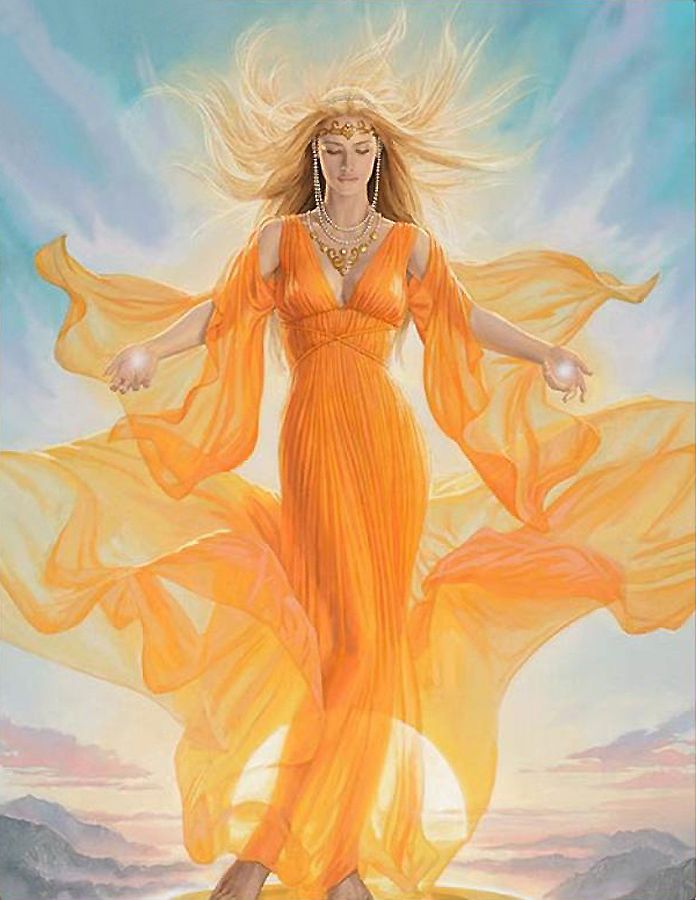
Some book recommendations on the solar feminine:
- Sun Lover Goddess Myths (x)
- Drawing Down the Sun by Stephanie Woodfield
- O Mother Sun! by Patricia Monaghan
- The Sun Goddess by Sheena McGrath








 Idylls of the Queen