
Well, it’s been a hot minute!
I know I’ve abandoned this blog, and I can’t say for sure that I’m ‘back’, but I am going to try to post on here at least once a month going forward.
For the last 3 weeks or so I’ve not been in a great mood, ranging from just kind of low to completely emotionally distraught to feeling just numb inside. I deactivated Facebook, stopped replying to inboxes and have spent a lot of time just enjoying my own company and resting, experiencing an inner winter even as spring is blooming.
Today is the spring equinox, with the fixed modern pagan observance of Ostara happening tomorrow on the 21st. Walking to and from work this week has been lovely. Monday in particular had beautiful weather and I decided to walk to work instead of getting the bus, but regretted wearing a jumper, leggings, long boots and my winter coat when I could’ve at the very least gotten away with my denim jacket instead of the coat. It’s that awkward time of year where you never know how to dress.
I always really notice a palpable energy shift this time of year. I don’t just mean because the weather is different and because the earth looks different, but it feels almost like in late March we’ve stepped into a slightly different version of the world. It’s not something that can be described logically with words, but something you just feel with your body & soul. In the Celtic traditions, liminal spaces are seen as extremely magically potent. The shift from winter into spring and the shift from summer into autumn are, to me, the most magically potent times of year because they are extremely liminal. The shifts from autumn to winter and spring to summer are noticeable too, but not almost as much.
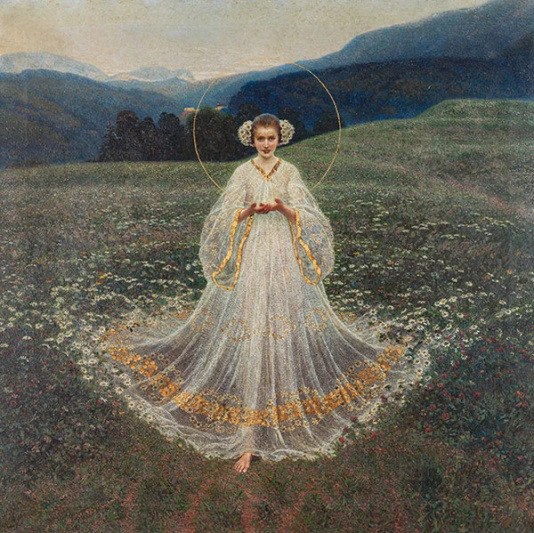
Many of the trees are covered in lovely, delicate pink blossoms. The Earth Goddess wears the mantle of the Spring Maiden. Women’s mystery traditions such as Dianic Witchcraft and the Glastonbury Avalon tradition observe the seasons as the Goddess ageing, dying and being reborn, and work with the uncanny resembles that has to the cycles in human women’s own lives, be that on a macro level (birth to death), or a micro level (our menstrual cycles). Other Neopagans view the Goddess as ageless and it is instead it is Her son or lover who goes through this process. Some see it as both. In the Filianic tradition which I used to be a part of and still somewhat align with, as Neoplatonists it is believed that the cycles of the earth reflect eternal truths and metaphysical events that take place outside of matter, time and space. In Filianism, the Spring Equinox and the days leading up to it are observed as the death and rebirth of God the Daughter, the World Soul who mediates the light of the Divine Mother to us here on earth.
Goddesses who embody the archetype of the young spring maiden (who I typically see as a teenager of about sixteen years old) include Ostara/Eostre (who, regardless of whether or not she was an invention by the monk Bede or actually worshipped, certainly is a goddess who is worshipped and adored today so it doesn’t matter. I also personally do believe she was really worshipped, and an obvious descendant of the H₂éwsōs lineage of Indo-European dawn goddesses), and Kore/Persephone. You could broaden this to include Brigid, though I’m specifically talking about goddesses often associated with this time of year and Brigid is obviously more associated with Imbolc. Similarly, you could broaden this category to include the May Queen goddesses such as Flora, Olwen, Gwenhwyfar, Creiddylad and Blodeuedd, though in terms of women’s mysteries archetypes I see them as embodying the Lover archetype which I see as a woman in her twenties, and they are obviously more associated with Beltane.
The element and cardinal direction associated with the season of Spring will differ depending on your tradition. In the Glastonbury Avalon tradition, it is associated with the cardinal direction East and the element of Fire. In Filianism, it is also associated with the cardinal direction East but instead of Fire, the element of Water. I can see arguments for both of these. On the one hand, the sun rises in the East and Spring is associated with the rising of the sun, which is a huge ball of fire. Fertilising heat quickens and awakens the land from slumber. On the other hand, it also makes sense for Summer to be associated with Fire instead, leaving Water for Spring. In many parts of Europe, especially here in the UK, Spring (especially March and early April) still tends to be very wet (although this is changing due to global warming).
But related to the idea that spring is the season of water, I wanted to explore a quote I read about the Spring Maiden recently, and relate it back to my life and personal journey at the moment.
“Ostara is usually experienced as a young maiden – as Ember Cooke writes, ”…old enough to bear children, but not a mother.“ She is wreathed in flowers or new greenery, and often dances.
She is often joyous, but can just as easily turn suddenly solemn, like the spring weather that can quickly turn to rain.
Like Spring itself, she is capricious, innocent and knowing by turns.
Hail to the Maiden of Spring, the dawning of the year! Bring freshness into all our lives.”
I have been feeling so upset with myself for not feeling all positive and perky now that spring is here. But just as I was able to partially heal my fear of getting older by observing that many of the most fecund, passionate, lusty beautiful gifts of the Goddess of Love and Beauty don’t occur until mid summer (roses) to late summer and early autumn (apples), once again Nature teaches me that to embody the Spring Maiden isn’t always to be a smiling, dancing, positive sweetheart. Patriarchal modes of being and thinking love femininity when it’s all pretty pink blossoms and giggles and a soft touch, yet they shame our emotional expression, complexities and depth. This is why it’s incredibly important to recognise when men say they want feminine women if they want feminine women in their fullness, or feminine women who are only feminine when it benefits them. The Spring Maiden archetype is one of two feminine archetypes that patriarchy has accepted the most, as well as the abundant Summer Mother, but even these archetypes have aspects that patriarchal men who don’t actually like femininity (even if they insist they do) are threatened by.
Water is the element of emotion, and so if we believe spring to be the season of Water, that means accepting the Spring Maiden for all these She is, not just the easy-to-appreciate pleasant parts, and for all that we are, too. And so, it’s okay that I’m struggling right now. My rain-clouds are just as beautiful as my blossoms.
The Spring Maiden is identical to the Dawn Maiden. Dawn and Spring symbolise hope, renewal, and indomitable innocence and optimism that refuse to be crushed by the cruelty of the world. Sadness only becomes all-consuming once you abandon the spirit within you that believes KNOWS things can get better. I might be lonely and hurting over my dating prospects right now in a world that seems to be abandoning virtue, monogamy, marriage and family, but I refuse to believe that all men are like that and that chivalry and romance are completely dead, no matter how many voices tell me they are. On a much more important note I look at what’s going on in Palestine at the moment and while it’s incredibly tempting to just lose yourself to despair, I see beautiful smiling, laughing children in refugee camps, and I remember that if they can keep their innocence and hope alive, I have to, too. For them, for myself, and for the world. Evil only wins once we lose hope that it can be defeated. “We’ll cry tonight, but in the morning we are new // Stand in the sun, we’ll dry your eyes.” – Arise, Flyleaf.
You can listen to my Ostara playlist here.
~ Rhianwen

 Idylls of the Queen